
Searching Dunklin County Criminal Dockets
Missouri Case.net is the free public entry point for a Dunklin County criminal docket. If a court paper gives you a case number, type it in exactly. No number? Use Litigant Name Search. Pick Dunklin County and the 35th Circuit, and narrow the filing-date range. Names can be tricky. A search may pull up several people or cases that share a name. Confirm the match through the case header and its dated history before trusting a result.
Case.net also lists scheduled hearings, which helps with a future Dunklin County setting. Note the case category, filing date, status, and division. Check these for the Dunklin County case before you count on an event taking place. The public system is only a window, though. The official file sits with the Dunklin County Circuit Clerk. So when you need a document, write down its title and check whether the entry shows a public link. The linked Dunklin County case lookup also works well. Use it when what you have is a name or case number rather than a docket event.
- Open Case.net and choose a criminal search path for Dunklin County.
- Enter the exact Dunklin County case number, or a litigant name with a filing-date range.
- Open the matching Dunklin County case header and confirm its category, date, and division.
- Read the Dunklin County criminal docket history in date order, separating a filing from a ruling or final disposition.
- Ask the Dunklin County Circuit Clerk about a public copy or certified judgment if the docket entry alone is not enough.
Dunklin County Criminal Docket Court Days
The county's Judicial System schedule sets criminal court on Tuesday and Thursday. It lists Dunklin County Division I and Division II as the criminal and civil divisions. Dunklin County Division III handles probate and juvenile work instead. That division split matters when you match a docket result against a hearing notice. Adult criminal cases belong in Division I or Division II. They do not sit in the probate and juvenile division just because the county shares one circuit.
A listed court day promises nothing. It does not mean every Dunklin County criminal docket gets called or resolved that day. Check the latest setting entry. Check any continuance after it. The division shown on the case tells you more than a recurring calendar. For a time-sensitive question, set the case history beside Scheduled Hearings & Trials. Then confirm the setting with the Dunklin County clerk's office.
Note: The recurring schedule helps route a Dunklin County question. But the current case entry controls the actual criminal hearing.
Inside a Dunklin County Criminal Docket
Missouri Court Operating Rule 4 defines the official court record. It is the filed documents plus the docket or backer-sheet material. So a Dunklin County criminal docket holds more than a hearing date. The header usually names the court and division. It adds the case number, case type, filing date, visible parties, and status. Below it, the dated history tracks each step. It records an information, an appearance, a motion, a setting, an order, a plea, a judgment, or a sentence. Read each Dunklin County entry for what it actually says. A short status label is not a substitute for the entry itself.
| Case category | CR is Missouri's criminal category. The statewide rule uses a year, location identifier, category, and sequence, but no exact current Dunklin location identifier was located. |
|---|---|
| Charge | The recorded Dunklin County offense or allegation at filing. A filed charge is not proof of guilt or a conviction. |
| Bond and counsel | Dunklin County release or attorney entries that can change and should be read with their date. |
| Setting and plea | A Dunklin County arraignment, pretrial, hearing, trial, or plea event. A calendar entry does not state the outcome. |
| Disposition and sentence | The Dunklin County court's stated result and punishment or conditions, not a report of later compliance. |
In a Dunklin County criminal docket, the gap between a motion and an order matters most. A motion asks the court to act. An order records what the court decided. Give the same attention to an amended charging document, a plea entry, and a final judgment.
Dunklin Criminal Docket Codes
Dunklin County criminal docket entries follow standardized Missouri terminology, yet a title still has to be read in context. Court Operating Rule 4 sets out the record fields behind a criminal or traffic backer sheet. The terms below help separate a case event from the legal result it may later produce.
- AINFO
- Information Filed, a prosecutor's criminal charging document entered on a Dunklin County docket.
- Arraignment
- An early Dunklin County court setting where the case moves forward; the entry must be read for the action taken.
- Disposition
- The recorded result of a Dunklin County charge or case, such as dismissal, acquittal, conviction, or another stated outcome.
- FTA
- A Dunklin County failure-to-appear notice or related entry. Its current status should be confirmed from the latest court record.
- ECASE
- A Missouri File Viewer label indicating an electronic Dunklin County case, not a promise that every document is public online.
A Dunklin County criminal docket can also show a warrant, a probation review, or an MSHP abstract date. Those are court-record fields, nothing more. Treat them as docket entries, not as a criminal-history report, a driver record, or a claim about anyone's present status.
How a Criminal Case Moves
A Dunklin County criminal case usually opens with a charging paper or similar initiating record. The Dunklin County clerk opens the case. The docket then fills with settings, notices, appearances, motions, and orders. An arraignment is one early criminal setting. Pretrial entries often follow. From there, a plea or trial can lead to judgment and sentence. Later Dunklin County entries may include probation reviews, payment notices, appeals, or enforcement activity. The record stays public.
Docket flow: Charge Filed › Arraignment › Pretrial Settings › Plea or Trial › Disposition › Sentencing
Few Dunklin County criminal dockets move in one straight line. A continuance moves a date. An amended information changes the charging entry. And a filed motion proves nothing about whether the court granted it. Read the record in order. Let the latest order and disposition outweigh an earlier setting.
Dunklin Criminal Docket Remote Files
Not every docket entry opens from your couch. A Dunklin County criminal docket can name a filing. Yet it may show no document you may view remotely. The Missouri Courts' File Viewer help draws that line. A hyperlink can lead to a document at your permitted security level. An entry with no link may have no attachment at all, or it may be restricted. So an unlinked line on the docket is not proof that the paper is hidden. It may simply live somewhere else.
Where does that leave older material? The official remote-access plan sets a cutoff. Public documents filed on or after July 1, 2023 became eligible for remote viewing once local implementation finished. The 35th Circuit was scheduled to implement no later than November 1, 2023. Even so, security settings and document status still govern each Dunklin County file. Access is decided one entry at a time. The Missouri judicial remote-access notice explains this transition. Some older public records may survive only at a Dunklin County courthouse terminal. A terminal view never grants permission to see a sealed document. A docket entry may lack a remote attachment. Ask the clerk whether a terminal, a paper copy, or a redacted version exists.
Note: A Dunklin County document's electronic label and its public docket entry do not guarantee the same level of access for every viewer.
Courts That Hold Criminal Dockets
Which court holds the file? Dunklin County sits in the Missouri Circuit Court, 35th Judicial Circuit. The county's official judicial page assigns ordinary criminal and civil work to Division I and Division II. Municipal divisions handle city-ordinance matters. Those records stay inside the state court structure even when a city runs the local court administration. The Dunklin County Circuit Clerk keeps the circuit-court case record itself. The county administrative clerk does not. That office holds commission, election, and county-government records, not a Dunklin County criminal docket.
Two other doors matter. Federal charges never show up in Case.net. A federal case belongs with the federal clerk and the PACER and CM/ECF court record system. Appeals from Dunklin County generally land in the Missouri Court of Appeals, Southern District. Neither route changes the local picture. The Dunklin County Circuit Clerk remains the custodian of the state criminal case file.
Dunklin Criminal Docket Copy Requests
Once Case.net points you to the right Dunklin County criminal docket, write down the details before you call. Keep the exact case number, the entry date, the document title, and whether you need certification. The Circuit Clerk can then route a request for a docket printout, an ordinary copy, a certified judgment, or another court record. The clerk sets no posted countywide copy schedule. Ask the current fee before you send payment. A transcript is a different animal. It may need a court reporter or a clerk referral first.
Dunklin County Circuit Clerk
Paula Gargus, Circuit Clerk
Justice Center
1175 Floyd Street
Kennett, MO 63857
573-888-2456
Monday through Friday, 8:00 a.m. to 4:30 p.m.
Dunklin County's Circuit Clerk office page names this office as custodian of the court records. Put the essentials in writing. Include the case number, division if known, the document or date range, the format you want, and whether certification is required. Check with the office on how to submit. Confirm the current accepted channel, whether mail, fax, email, or drop box, before sending anything.
Sealed Dockets and Public Access
Access to a Dunklin County criminal docket starts with Missouri court rules. Never assume every file is open. "Public access" can mean several things. A remote docket entry, a courthouse-terminal view, a public document link, a clerk copy, or a certified copy. Each opens a different door. The court's public-access framework presumes access, but procedure, security, confidentiality, sealing, and applicable law all condition it. Before relying on a specific Rule 2 subsection, read the current promulgated text.
Key Rules:
Missouri Court Operating Rule 2 public-access material describes access as subject to security, confidentiality, sealing, and law.
Court Operating Rule 4 defines the official record and requires public-access equipment or legible records.
RSMo §610.120 limits unauthorized inspection of closed records and does not yield to an ordinary public request.
Treat a Dunklin County criminal docket result as the court's event record, not a full inventory of every underlying paper. A public Dunklin County case can still hold a confidential document. The docket entry may stay visible while its attachment stays unavailable.
Dunklin Criminal Docket Access Limits
Missouri's closed-record statute frames the outer limits of any Dunklin County criminal docket request. It explains which records the law closes to ordinary document access.
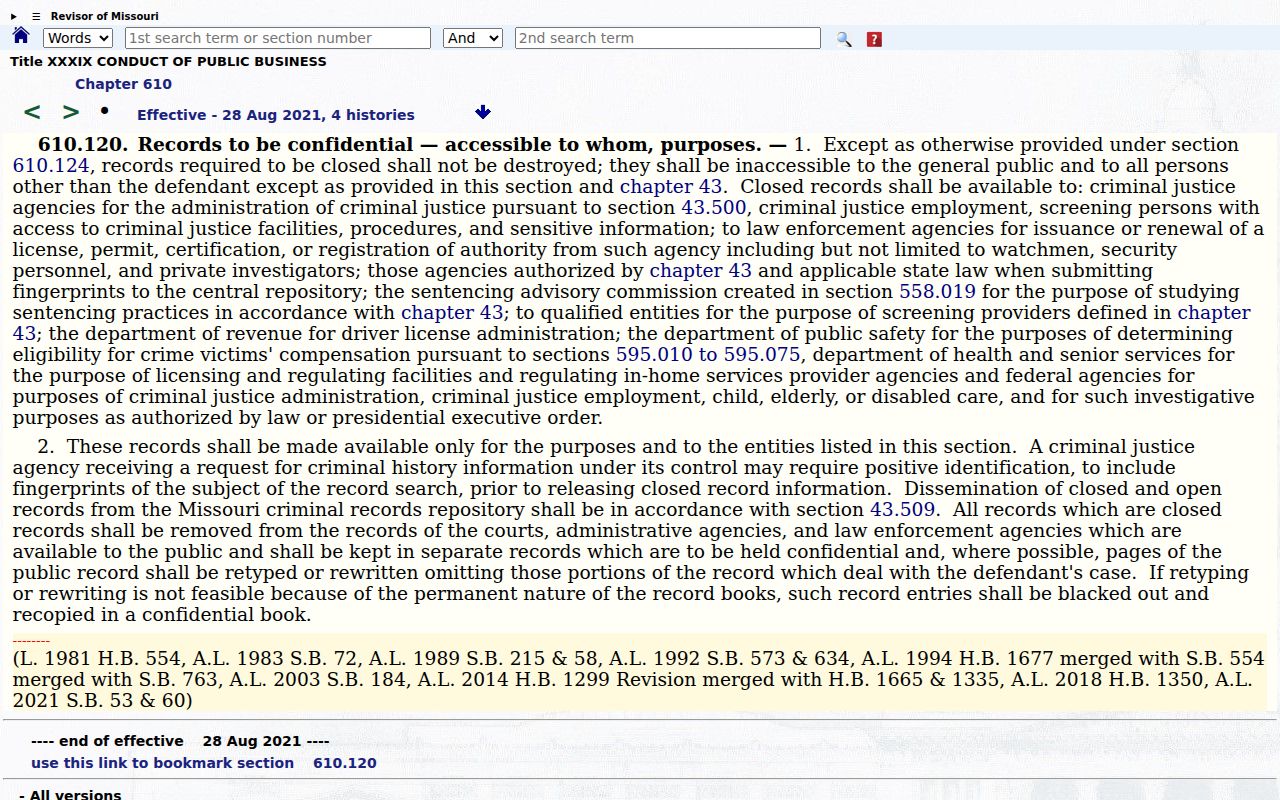
Closed Dunklin County records are not generally open to unauthorized inspection. An entry might be unavailable. Ask the Dunklin County Circuit Clerk which rule, statute, order, or public redacted alternative governs the result. Never ask staff to bypass a seal or a security classification. For juveniles, the Missouri Courts' Rule 122.02 guidance applies. It covers access to Dunklin County juvenile pleadings and orders in specified proceedings.
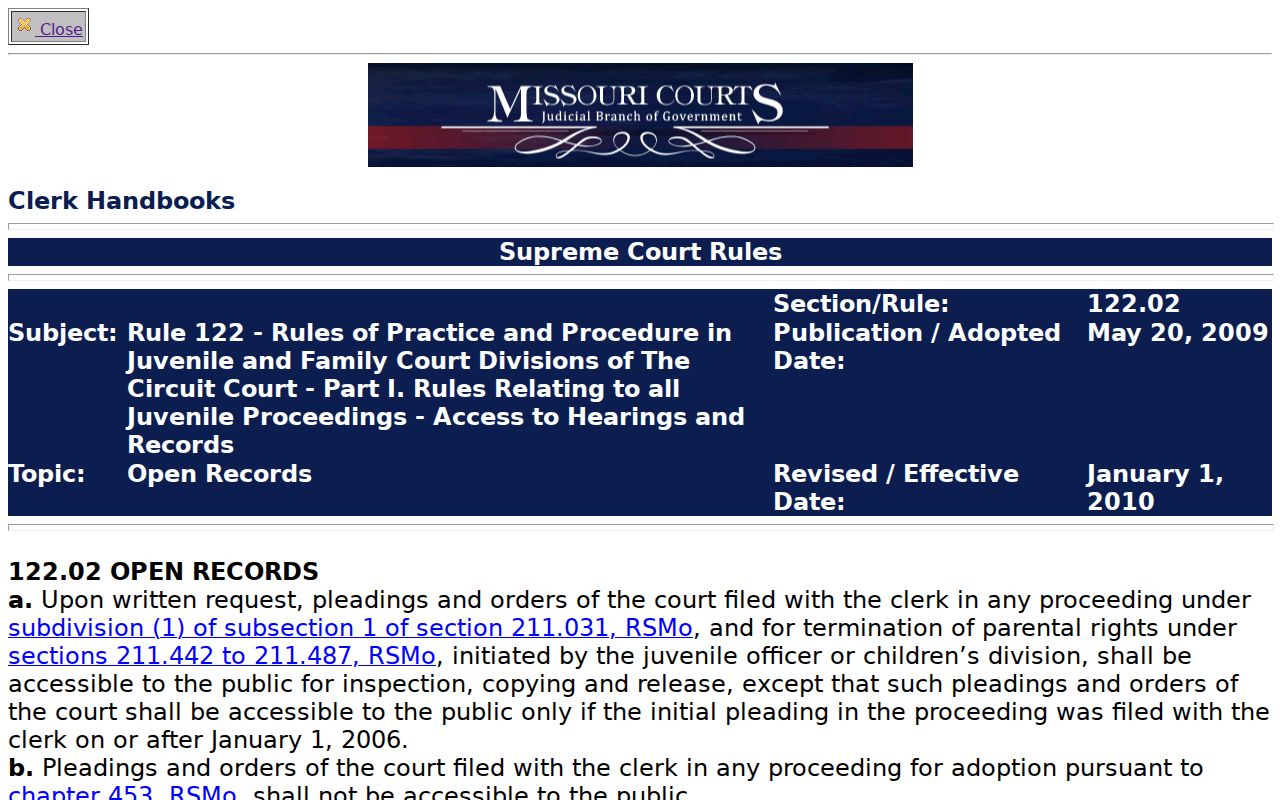
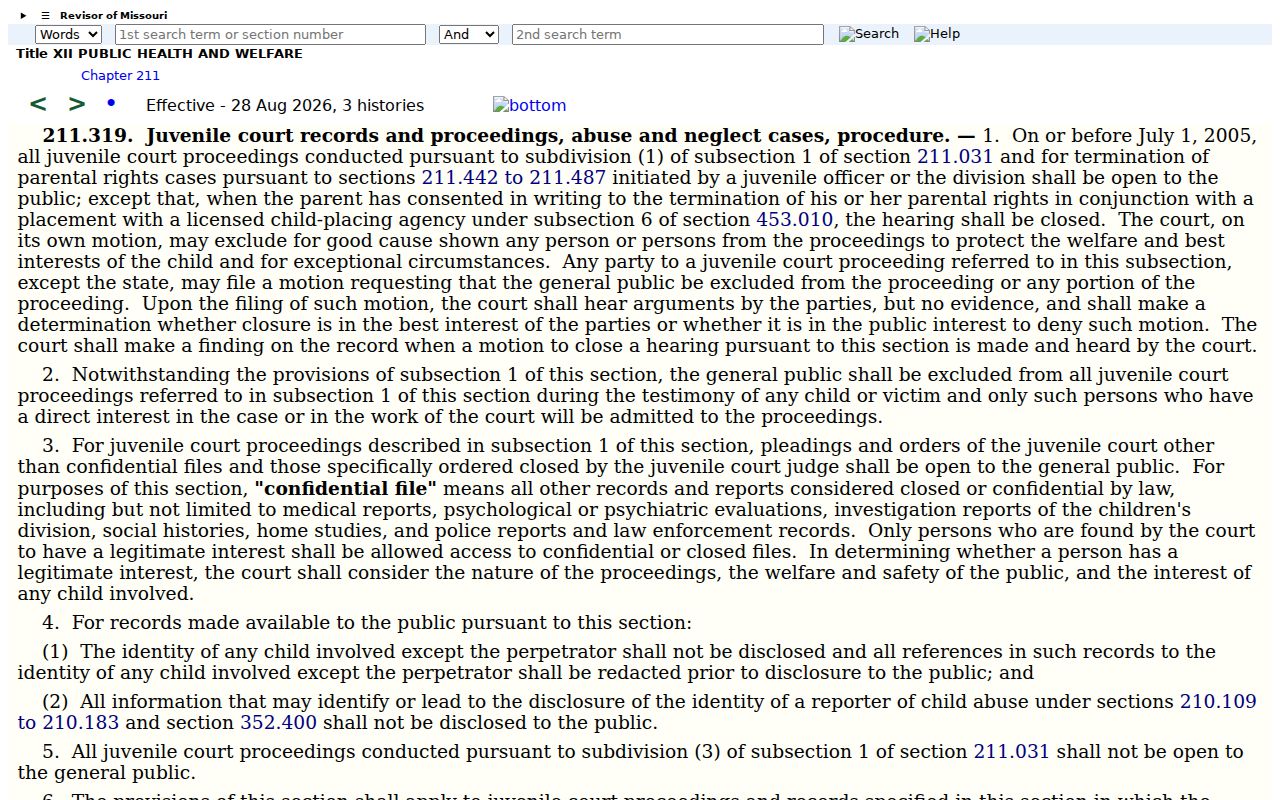
A juvenile office phone number does not turn a juvenile file into an ordinary public criminal docket. Some Dunklin County requests demand a written showing of legitimate interest, redaction, or a judge's order. RSMo §211.319 is the official source on juvenile-record confidentiality in Missouri.
Even when much of a Dunklin County criminal matter is public, sealed, expunged, mental-health, victim-protected, grand-jury, presentence, and other confidential material can stay restricted. Work the fallbacks in order: Case.net, a courthouse terminal where permitted, a narrow clerk request, and court authorization when the rule demands it.